Sampling & Quality
A Practical Checklist for Showerhead Sample Approval
Author·AMIKYRN Team·
Sample approval is the last gate before mass production. The approved sample becomes the standard for the bulk order — once you sign, later changes cost rework and delays. So don't just glance at it and say fine. Check the items below one by one, and send all feedback at once.
1. Set the sample plan first: how many stages does sampling take?
Sampling is not done in one pass. From prototype to mass production, the sample goes through these stages, with a review at each one:
- Functional prototype: Produced after structural design. A working prototype — confirm the functions first. Appearance may differ by up to 10%; this stage is not about looks.
- Appearance prototype: An appearance prototype with CMF effects (color, material, finish) — confirm the look. Appearance satisfaction must be 90% or higher.
- T0: First trial molding, producing samples at about 80% of the final state, exposing basic issues.
- T1: Mold repair plus color samples, with reliability testing running in parallel — test and fix at the same time.
- T2: Acceptance and closure of T1's remaining issues. In theory, all known issues are resolved at this stage.
- Sign-off: After T2, the factory sends the perfect sample for your sign-off.
- Small batch: About 200 units in a small-batch run, to smooth out the production line and make internal factory optimizations. The updated small-batch samples are sent back to you for another round of confirmation.
Fix colors (color codes/standards) and logo files before sampling starts. If they come late, every earlier stage has to be redone.
2. First, lock the version: sample reference and spec version
- Sample reference: Give each sample a reference number. When several arrive together, identify them individually so comments stay attached to the right sample.
- Spec version: Record the drawing or specification version the sample was made to.
- Received list: Check model, color, configuration, and accessories against what was agreed.
- Agreed differences: If the sample intentionally differs from the production configuration (e.g., a substitute color for sampling), write it down — don't rely on verbal memory.
- Keep records: Delivery photos and the supplier's sample description, stored with your feedback.
3. Appearance and dimensions checklist
- Appearance: Faceplate, color, logo placement, overall shape — compare with the agreed reference or rendering.
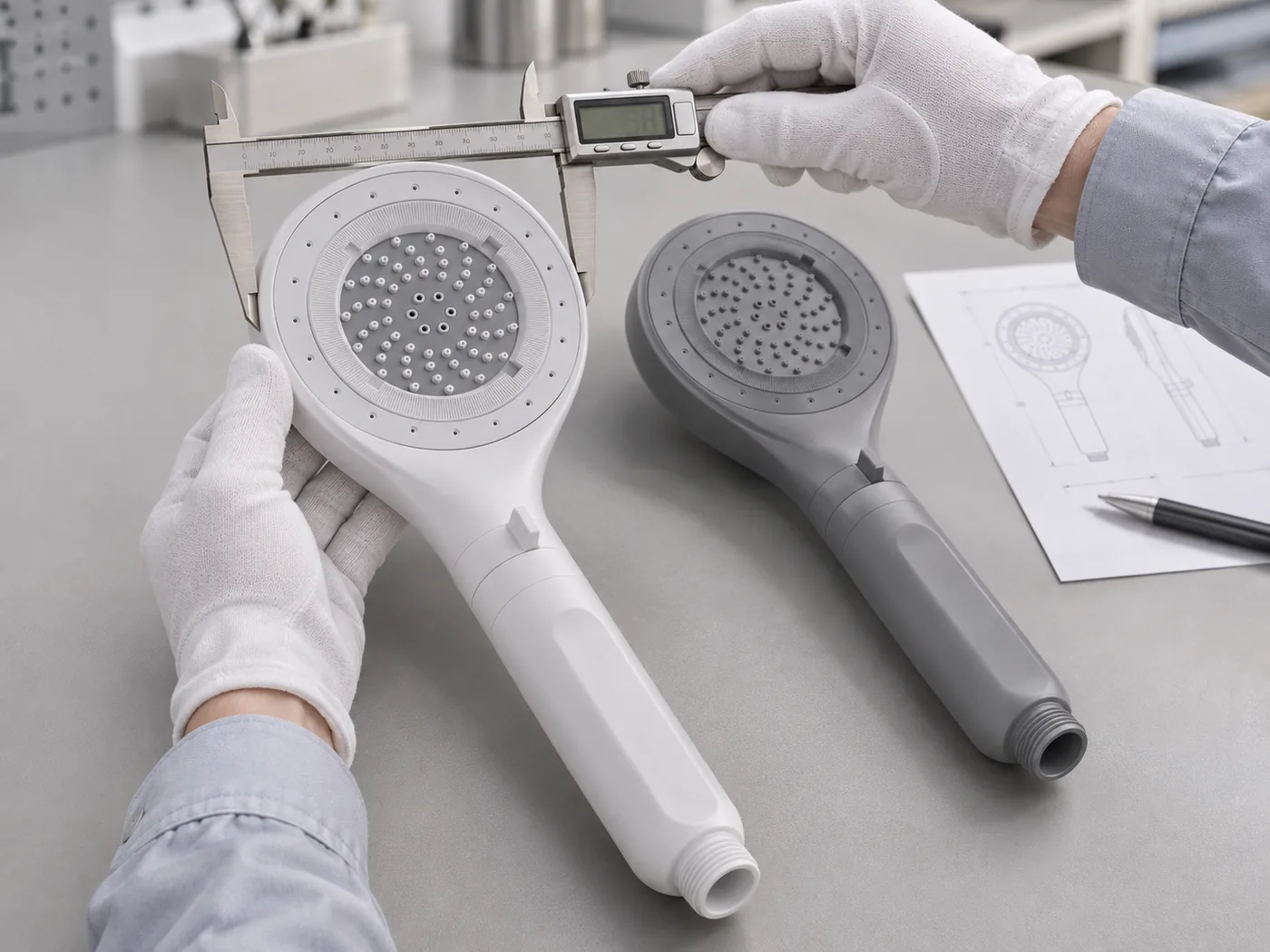
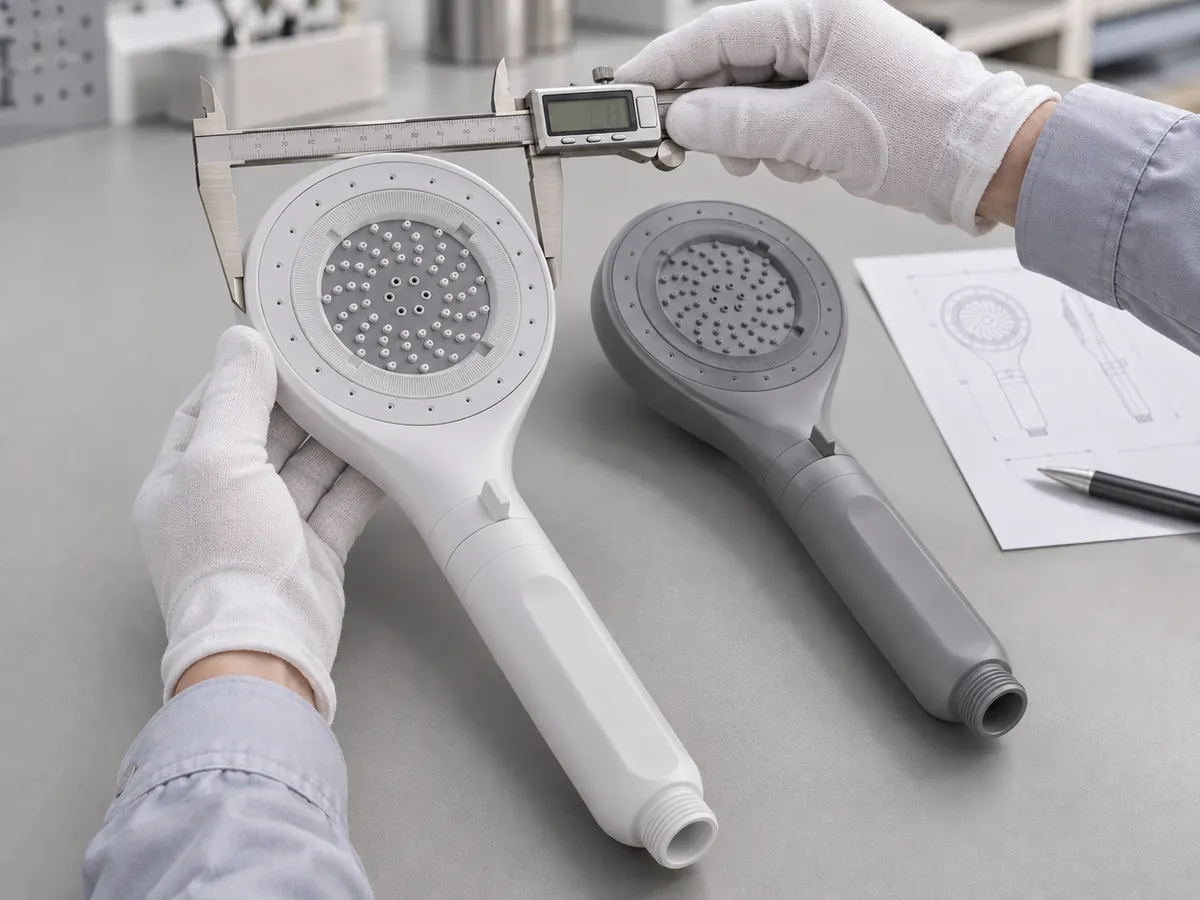
- Dimensions: Check key dimensions against the drawing (Amikyrn shower head: about 100 × 267 × 32 mm). Record the measuring tool and which points you measured.
- Weight: About 240 g. Weigh it, and ask if it doesn't match the agreed value.
- Surface: Scratches, color differences, burrs — photograph each concern showing its location and scale, and state what you need the supplier to review. The finished-product inspection standard specifies the allowable number of scratches and particles — ask the supplier for this standard before sign-off.
- Feel: Grip, button or selector movement — check for sticking or looseness.
4. Running-water test checklist
- Test conditions: Test at the recommended 0.15 MPa (working range 0.1–0.4 MPa). Record the actual pressure and the water setup — pressure and piping affect what you see, and without them both sides can't compare notes.
- Test all three modes: Nanobubble, Enhanced, and Pulse — check each mode's spray separately, and name the mode when reporting an issue.
- One-touch stop: If the configuration includes one-touch stop, check that pressing it stops the water fully and releasing it restores flow.
- Connection: Connections are made to your target market's national standard — G1/2 in most markets worldwide, 1/2-inch NPT in North America, G1/2 on current Japanese products, with K, M, and G adapters for legacy KVK, MYM, and Gaster hoses. Confirm the sample's connection matches the one your target market requires.
- Reliability testing: The factory runs reliability tests simulating real-world conditions (e.g., thermal cycling, pressure redundancy) to make sure the product holds up under extreme conditions. Before sign-off, ask the supplier for the reliability test list and results.
- Record video: Film the running-water test and attach it to your feedback — video explains spray issues better than words.
5. Connections and accessories
- Included parts: Hose, bracket, and other agreed accessories — check each one is present and to spec.
- Fit: Mount the shower head on the hose and into the bracket; check tightness, angle, and whether it sits steadily.
- BOM match: Compare received accessories against the agreed bill of materials, item by item — note anything missing or extra.
- Interface details: For a fit problem, photograph the connection close up and state whether it won't screw on, leaks, or wobbles.
6. Packaging and documents
- Unbox as a customer: Open the box the way a customer would; check the contents are complete and placed as agreed.
- Tray and protection: Check the insert fits, contact points are protected, and the product can be removed easily.
- Manual and labels: Compare the manual, labels, and box artwork against the current file versions, and record version numbers.
- Transport testing: If transport testing is required, agree the method and pass criteria with the supplier in advance.
7. How to decide: approve, approve with conditions, or reject
Approve: Everything matches the agreement. Sign it off — this sample becomes the bulk standard; keep it sealed as reference.
Approve with conditions: Small issues that can be fixed in production (e.g., a print typo, a minor insert adjustment). List each change and how it will be confirmed; the supplier replies to each in writing. No new sample needed.
Reject: Issues affecting appearance, function, or structure (e.g., wrong spray in a mode, out-of-tolerance dimensions). The supplier must fix and re-sample, and the review starts over.
Rule of thumb: if the change affects tooling, structure, or function, reject and re-sample; if not, approve with conditions.
8. Copy-ready sample feedback form
Replace the bracketed parts with your project details and send it to the supplier:
Sample reference: (reference), Spec version: (drawing/spec version)
Sample stage: (functional prototype / appearance prototype / T0 / T1 / T2 / sign-off / small batch)
Received date: (date)
Appearance & dimensions: (approved / issue + photo)
Running-water test: (pressure, three-mode results, one-touch stop result + video)
Connections & accessories: (approved / issue + photo)
Packaging & documents: (approved / issue + photo)
Decision: (approve / approve with conditions / reject)
Changes required: (each item: what to change, how it will be confirmed)
Next step: (mass production / confirm after change / re-sample)
Frequently asked questions
- Who is responsible if the bulk goods don't match the sample?
- The signed-off sample and spec version are the reference. Make sure the sample reference and spec version are written into the contract or order attachment before production, so any dispute is settled against them.
- Do I have to film the running-water test?
- We recommend it. Spray effects are hard to describe in words; video lets the supplier see the issue directly and saves a round of back-and-forth.
- Does every change need a new sample?
- It depends on the change. Changes to tooling, structure, or function need a new sample; print or insert tweaks can go through as approve-with-conditions and be fixed in production per the written confirmation.
- How many rounds does sample approval usually take?
- It follows the stages — one review per stage: functional prototype → appearance prototype → T0 → T1 → T2 → sign-off → another round after the small batch. Complete feedback with photos and video the first time keeps rounds within plan; feedback sent in dribs and drabs adds extra rounds.
Plan a review that fits your showerhead project
Share your sample requirements and target market with AMIKYRN. We can discuss the product details to confirm, the information needed for review and the next sampling step for your OEM/ODM project.
Discuss sample requirements